How long is a hockey game? Periods, intermission and overtime
How long do hockey games last in practice? The clock says sixty minutes; allow about two and a half hours from the first face-off to the handshake. Here is where the rest of the time goes.
Section one
The short answer
How long is a hockey game from start to finish
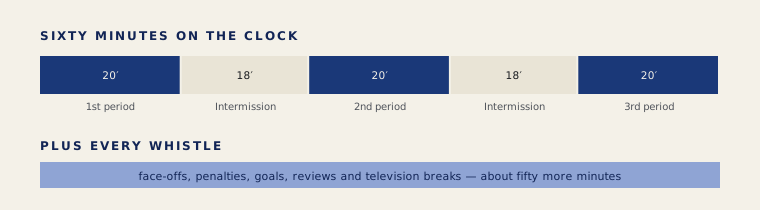
How long is a hockey game? Sixty minutes on the clock, and about two and a half hours in the building. That is the answer for the NHL, the AHL, the ECHL and college hockey alike, because they all use the same structure: three periods of twenty minutes with two intermissions between them. Ask how long do hockey games last at any of those levels and the answer barely moves.
The gap between sixty minutes and one hundred and fifty exists because the clock only runs while the puck is in play. Every whistle stops it. Add two intermissions of fifteen minutes or more, and the hockey game length that matters — the one that decides when you get home — is roughly two and a half times the clock. Anyone asking how long is a hockey game is usually asking about that number rather than the sixty.
Three periods, and why not halves
Hockey settled on three periods rather than two halves for a practical reason: ice. Early rinks degraded badly under skates, and breaking the game into thirds gave two chances to resurface instead of one. The convention stuck, and modern ice-making has not changed it. How many periods in hockey is therefore always three, at every level that uses a full sheet. The question of how many periods in hockey has the same answer in the ECHL as in the NHL.
Intermission: fifteen minutes, twice
An intermission is fifteen minutes at most levels and seventeen or eighteen where broadcasters are involved. Both are used to resurface the ice. In minor-league buildings the intermission is also when the between-periods promotions run, which is why they feel longer than they are. Of the two and a half hours that answer how long is a hockey game, half an hour is intermission.
Overtime, and how much it adds
A tied regular-season game goes to five minutes of three-on-three overtime, sudden death. If it survives that, a shootout settles it. Together they add ten to fifteen minutes. Playoff overtime is a different thing entirely: full twenty-minute periods, five-on-five, repeated until somebody scores, with a full intermission between each one.
Section two
Common questions
How long do hockey games last, in detail
The hockey game length depends on the level, the tie, and how many penalties the referees call. These are the questions people actually ask, with the short answer to each.
How long is a hockey game in real time?
Around two and a half hours for a professional game that finishes in regulation. Sixty minutes of clock, two intermissions of fifteen to eighteen minutes, and the accumulated stoppages for face-offs, penalties, television breaks and goal reviews.
How many periods are in hockey?
Three, each twenty minutes of running clock. Hockey does not use halves or quarters. The teams change ends after every period, which is why the third period puts each team at the far end from its own bench.
How long is an intermission in hockey?
Fifteen minutes at most levels, seventeen or eighteen where there is a television contract to serve. There are two of them, one after each of the first two periods, and the ice is resurfaced during both.
What happens if the game is tied?
In the regular season it goes to a short overtime period of three-on-three hockey, five minutes long and sudden death. If nobody scores, a shootout decides it. In the playoffs there is no shootout: teams play full twenty-minute overtime periods, five-on-five, until someone scores.
How long does overtime add?
A regular-season overtime and shootout together rarely add more than fifteen minutes. A playoff overtime is open-ended; multiple-overtime playoff games have run past six hours.
Why does the clock stop so often?
The clock stops at every whistle: icing, offside, a puck out of play, a penalty, a goal, a frozen puck. A period of twenty minutes of play therefore takes roughly thirty-five to forty minutes of real time.
Is a minor-league game shorter than an NHL game?
No. The ECHL, the AHL and the NHL all play three twenty-minute periods. Minor-league games often finish slightly faster because there are fewer television timeouts, and the arenas are smaller, so the crowd clears quicker.
How long is a youth or college hockey game?
College hockey matches the professional format at three twenty-minute periods. Youth levels shorten the periods, commonly to twelve or fifteen minutes, and often run a continuous clock in blowouts.
What is OTL in hockey?
An overtime loss. A team that loses in overtime or a shootout still takes one point in the standings, so records are written as wins, losses and overtime losses, such as 45-22-2-3 where the last two columns split overtime and shootout defeats.
When do the doors open before a game?
Usually an hour to ninety minutes before the first face-off at minor-league arenas. Warm-ups start around half an hour before, on the ice, and are open to anyone already in the building.
Section three
Related
- The hockey glossary — what the words mean when the game is on
- How ECHL affiliation works
- Seventeen seasons of results, and what the record columns mean