Hockey terms A to Z: a glossary of hockey slang and lingo
Hockey slang is a real dialect, and most of it never gets explained on air. This is a plain glossary of the hockey terms that turn up in commentary, on the bench and in the stands.
Section one
How to use it
What counts as hockey lingo, and what is just a rule
Two different vocabularies get called hockey lingo, and this glossary carries both. One is the rulebook: icing, offside, cross-checking, the crease. Those words mean exactly one thing and an official will enforce them. The other is hockey slang proper — celly, duster, sauce, chiclets — which is invented in dressing rooms, spreads by broadcast, and changes by generation and region.
Both are in this list, because a spectator hears them in the same sentence. Rule words are defined as the rule defines them. Slang is defined as it is actually used, which sometimes means admitting that a word is an insult. Hockey terms from the rulebook are stable; hockey lingo from the room is not.
What this glossary covers: North American hockey slang and ice hockey terms
Almost every entry is North American ice hockey terms rather than field hockey, and a good deal of it is specifically minor-league. Field hockey and ice hockey terms overlap barely at all, so nothing here will help with the other game. Terms drift: a word that meant one thing in 2005 can be an affectionate insult by 2015. Where usage is contested the entry says so rather than picking a winner. The list runs to well over a hundred hockey terms and grows when a gap turns up.
Section two
116 terms, A to Z
A
- Apple
- An assist. Two apples is a two-assist night, and the plural turns up far more often than the singular.
- Attack zone
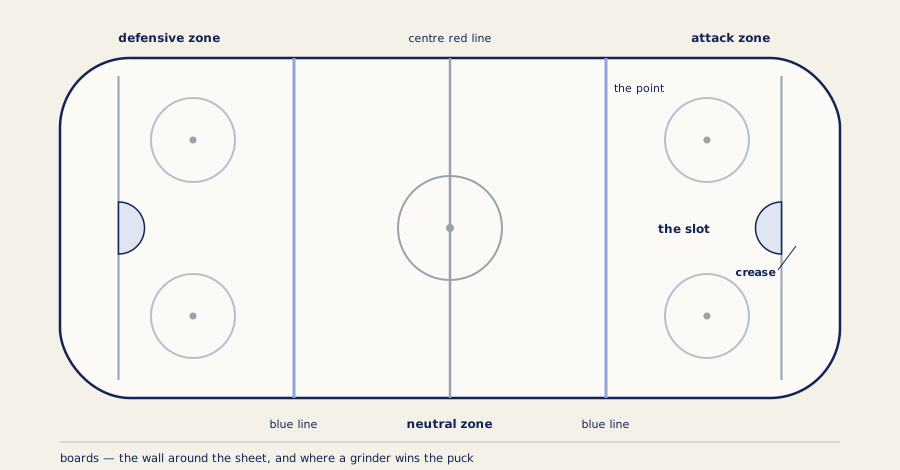
- The offensive zone: the ice between the opponent's blue line and their goal.
B
- Backchecking
- Skating back from the attacking end to defend, usually by forwards chasing the puck carrier.
- Bar down
- A shot that hits the underside of the crossbar and drops into the net. The most admired way to score.
- Barn
- A rink. Used affectionately, and more often about old buildings than new ones.
- Barn burner
- A high-scoring, loud game where the crowd never settles.
- Basket
- The net, as in putting the biscuit in the basket.
- Beauty
- A player who is good on the ice and good company off it. Shortened from beautician.
- Biscuit
- The puck.
- Blocker
- The rectangular pad on a goaltender's stick hand.
- Blueliner
- A defenceman, named for the line they are responsible for.
- Boarding
- A penalty for checking an opponent violently into the boards.
- Breadbasket
- A goaltender's chest, where a shot hits the logo.
- Breakaway
- A player in alone on the goaltender with no defender able to catch them.
- Bucket
- A helmet.
- Butt-ending
- Jabbing an opponent with the end of the stick shaft. A major penalty.
- Butterfly
- A goaltending style in which the goalie drops to cover the lower half of the net with the pads.
C
- Cage
- The wire mask on a helmet, or the net, depending on who is talking.
- Celly
- A goal celebration, and by extension how elaborate it was.
- Changing on the fly
- Substituting players while the clock is running rather than at a stoppage.
- Chiclets
- Teeth. Usually mentioned when somebody has lost one.
- Chirp
- Trash talk aimed at an opponent, their bench or the officials.
- Clapper
- A slapshot.
- Coast to coast
- Carrying the puck the length of the ice, from the defensive zone to a shot on goal.
- Crashing the net
- Driving hard at the goal to force a rebound, screen the goalie or create trouble.
- Crease
- The painted area in front of the net that belongs to the goaltender.
- Cross-check
- Hitting an opponent with the shaft of the stick held in both hands. A penalty.
D
- Dangle
- Beating a defender with stickhandling rather than speed.
- Deke
- A fake. To move the puck or the body one way to send a defender or goalie the other.
- Double shift
- Playing a strong forward on two lines to get them more ice time, usually when chasing a game.
- Dump and chase
- Shooting the puck into the offensive corner and pursuing it, rather than carrying it in.
- Duster
- A player who does not get on the ice much, and collects dust on the bench.
E
- Empty netter
- A goal scored into an unguarded net after the opposing goaltender has been pulled.
- Enforcer
- A player kept on the roster largely to fight and to deter opponents from taking liberties.
F
- Face wash
- Shoving a glove into an opponent's face after the whistle. More insult than injury.
- Faceoff
- The drop of the puck between two players that restarts play.
- Fishbowl
- A full clear plastic visor covering the whole face.
- Five-hole
- The gap between a goaltender's pads. The fifth of the five scoring areas.
- Flat pass
- A pass that stays on the ice the whole way.
- Flip pass
- A pass lifted over a stick or a skate to get it through traffic.
- Flow
- A player's hair, especially the part visible below the helmet.
- Forecheck
- Pressuring the opposition in their own zone to force a turnover.
G
- Garbage goal
- A goal scored from a rebound or a scramble rather than a clean chance. Counts the same.
- Gino
- A goal.
- Goal mouth
- The area directly in front of the net.
- Gordie Howe hat trick
- A goal, an assist and a fight in the same game.
- Grinder
- A hard-working forward who wins pucks in the corners rather than scoring.
H
- Hat trick
- Three goals by one player in one game.
- Headmanning
- Passing the puck up ice to the furthest forward player rather than carrying it.
- Healthy scratch
- A fit player left out of the lineup by choice.
- Heel of the stick
- The point where the blade meets the shaft.
- Hoser
- A loser, in the oldest and most Canadian sense of the word.
- Howitzer
- A very hard shot.
I
- Icing
- Shooting the puck from behind the centre line past the opposing goal line untouched. Play stops and the faceoff comes back.
L
- Laser
- A hard, accurate shot or pass.
- Lettuce
- Hair. Interchangeable with flow and salad.
- Lie
- The angle between a stick's blade and its shaft.
- Light the lamp
- To score. The red light behind the net is the lamp.
- Line
- The three forwards who play together, or the group as a unit.
- Lumber
- A stick.
M
- Man advantage
- Playing with more skaters than the opposition because of a penalty. The power play.
- Man on
- A shout warning a teammate that a checker is closing on them.
- Mitts
- Hands, in the sense of skill with the puck. Also gloves.
- Mustard
- Pace on a shot or a pass.
- Muzzy
- A moustache, usually grown for a cause or a bet.
N
- Natural hat trick
- Three goals in a row by one player with no other goal in between.
- Neutral zone
- The ice between the two blue lines.
- Neutral zone trap
- A defensive system that clogs the neutral zone to stop teams carrying the puck in.
O
- Odd-man rush
- An attack with more attackers than defenders back, such as a two-on-one.
- Offside
- Entering the offensive zone ahead of the puck. Play stops.
- One-timer
- Shooting a pass first time, without settling the puck.
P
- Pigeon
- A player who scores off the work of better linemates.
- Pinch
- A defenceman stepping up at the offensive blue line to keep the puck in.
- Pipe
- A goalpost.
- Playoff beard
- Facial hair grown for the duration of a playoff run and shaved only when the team is out.
- Point
- The position at the offensive blue line, usually held by a defenceman. Also a unit of scoring.
- Poke check
- Knocking the puck off an opponent's stick with a single jab of your own.
- Power forward
- A big forward who combines scoring with physical play.
- Power play
- The man advantage created by an opponent's penalty.
- Pretty goal
- A goal made by skill rather than luck.
- Pulling the goalie
- Replacing the goaltender with an extra skater, almost always when trailing late.
R
- Ragging the puck
- Keeping possession without attacking, to run down a clock or kill a penalty.
- Rebound
- A puck that comes off the goaltender and stays live.
S
- Salad
- Hair. See flow and lettuce.
- Sauce
- A saucer pass. As a verb, to lift a pass over a stick.
- Saucer pass
- A pass lofted off the ice so it flies over sticks and lands flat on the receiver's blade.
- Shadow
- A player assigned to follow one opponent everywhere.
- Shorthanded
- Playing with fewer skaters because of a penalty.
- Shutout
- A game in which a goaltender concedes nothing.
- Sieve
- An unkind word for a goaltender letting in soft goals.
- Sin bin
- The penalty box.
- Slot
- The scoring area in front of the net between the faceoff circles.
- Snipe
- A precise shot to a small target, usually a top corner.
- Sniper
- A player who scores that way regularly.
- Spin-o-rama
- A full turn with the puck to shield it and change direction.
- Stack the pads
- A goaltender throwing both pads sideways across the ice to block a low shot.
- Standing on his head
- A goaltender playing far above his usual level.
- Stay-at-home defenceman
- A defenceman who rarely joins the attack and concentrates on his own end.
- Stoned
- Denied by a good save.
- Sweep check
- A one-handed sweep of the stick along the ice to take the puck away.
T
- Tape to tape
- A pass that arrives exactly on the blade.
- The show
- The NHL, from the point of view of anyone playing below it.
- Tic-tac-toe
- Two quick passes and a finish, all in one movement.
- Toe drag
- Pulling the puck back with the toe of the blade to beat a defender's stick.
- Top cheese
- The very top of the net, under the bar. Also top cheddar.
- Top shelf
- The upper part of the net, above the goaltender's pads.
- Traffic
- Bodies in front of the goaltender obstructing the view.
- Trap
- Shorthand for the neutral zone trap.
- Twig
- A stick.
- Two-way centre
- A centre trusted at both ends of the ice.
W
- Wheeling
- Skating hard and well. Off the ice it means something else entirely.
- Wrap-around
- Carrying the puck around the back of the net and trying to stuff it in at the far post.
- Wrister
- A wrist shot: quicker to release than a slapshot and easier to place.
Z
- Zamboni
- The machine that resurfaces the ice, named after its inventor Frank Zamboni.
- Zebra
- A referee, from the striped shirt.
- Zone entry
- The act of carrying or sending the puck across the offensive blue line.
Section three
Related
- How long is a hockey game — periods, intermissions and overtime
- How ECHL affiliation works — call-ups, loans and assignments
- What the record columns mean — wins, losses and the overtime point
Questions
About hockey slang
Common questions about hockey terms
What is a celly in hockey?
A goal celebration, and by extension how elaborate it was. A restrained one gets no comment; an extravagant one gets remembered, and occasionally punched.
Why is the puck called a biscuit?
From the shape. The phrase people actually use is “put the biscuit in the basket”, where the basket is the net.
What is the five-hole?
The gap between a goaltender’s pads. The five scoring areas are numbered, and that is the fifth, which is why a goal through it gets its own name.
What is a Gordie Howe hat trick?
A goal, an assist and a fight in the same game. It is named for a player who was very good at all three and, by most accounts, rarely actually recorded one.
Is hockey slang the same in Canada and the United States?
Largely, because it travels by broadcast. Regional differences exist and generational ones are bigger — a word current in 2005 can be an affectionate insult by 2015.
Does any of this apply to field hockey?
Almost none of it. The two games share a name and very little vocabulary; everything in this glossary is ice hockey.
Elsewhere
Where the same ground is covered
- Ice hockey rulesThe rulebook side of this vocabulary, written out in full.